IPv6 Notes
Published: Fri May 29 2026
IPv6 address properties:
- 128 bits or 16 bytes
- Represented in hexadecimal format
- Separated by 16 bits, which are hextets
Rules to compact IPv6 address
- Rules to compact IPv6 address
- If a hextet has all 0s, then it can be replaced with a single 0.
- All the initial 0s of a hextet can also be skipped.
- Consecutive hextets with all 0s can be replaced with ::
Advantages
- Larger address space
- Simplified header
- Auto configuration
- End to end connectivity
- No broadcast
- Anycast support
- Mobility
Subnetting
48 - Prefix
16 - Subnet
64 - Host
/64 is the standard subnet size
/128 corresponds to a single host (similar to /32 in IPv4)
Examples
2001:db8:abcd::/48
48-bits fixed
16-bits subnetting - 2^16 = 65,536 subnets
64-bits for hosts - 2^64 = 18.4 Quintillion addresses
IPv6 address Types
- Global unicast 2000::/3
- Link-local fe80::/10
- Unique local fc00::/7
- Multicast address ff00::/8
- Anycast address
Well-known multicast Ff02::1 - 2240.0.0.1 Ff02::2 - 224.0.0.2
Neighbor Discovery
Types of Neighbor Discovery Messages
- Router Soliciation
- Router Advertisement
- Neighbor Solicitation
- Neighbor Advertisment
- Redirect (ICMPv6 Type 137)
Router Soliciation
- ICMPv6 Type 133
- A host will send an RA message to the multicast group ff02::2 to know about its gateway information.
Source MAC: MAC Address of Host
Destination MAC: Multicast
Source IP: Link-local address of Host
Destination IP: ff02::02
Router Advertisement
- ICMPv6 Type 134
- Router or Gateway will reply to RS or periodically send RA
- Can be sent as unicast also to multicast group ff02::1
Source MAC: MAC Address of the Router
Destination MAC: Multicast during periodic updates and Unicast when replying to RS
Source IP: Link-local address of the Router
Destination IP: Unicast or ff02::01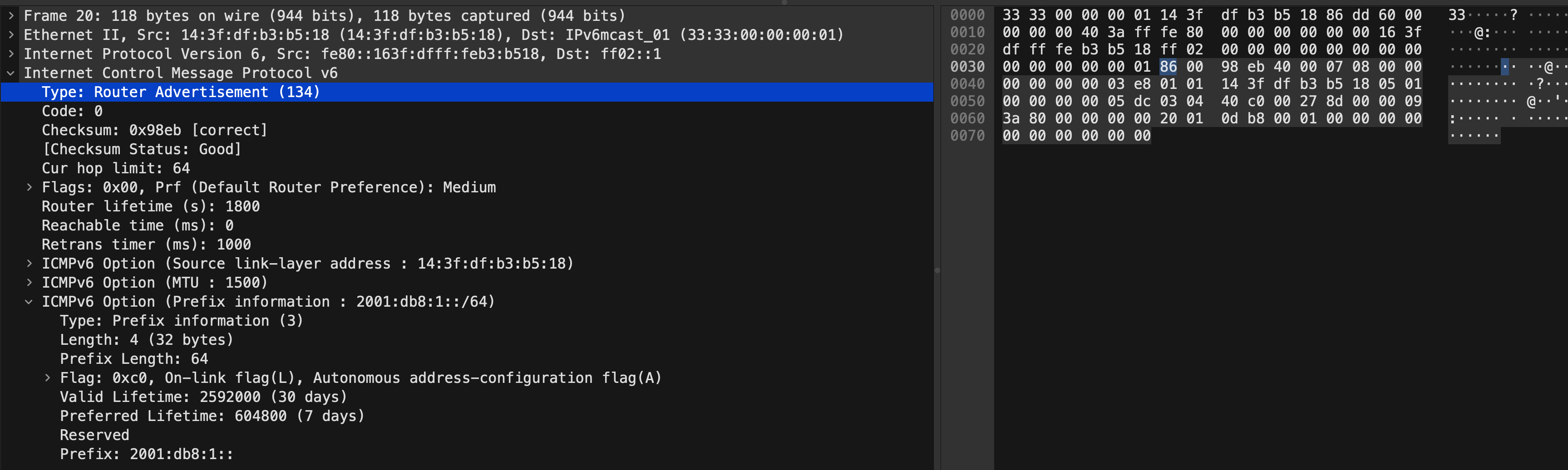
Neighbor Solicitation
- ICMPv6 Type 135
- Replacement to ARP request in IPv4
- Can be sent by the host or the router. The host will send to resolve the MAC address of another host. Similarly, the router will send to resolve another router’s MAC.
- Unlike broadcast in IPv4, here the destination will be the solicited-node multicast address. We will see later what the solicited-node multicast address is.
- Host will also send NS with its own address—Duplicate Address Detection (DAD).
Source MAC: MAC Address of the Host
Destination MAC: Multicast during periodic updates and Unicast when replying to RS
Source IP: Link-local address of the Router
Destination IP: Solicited-node multicast address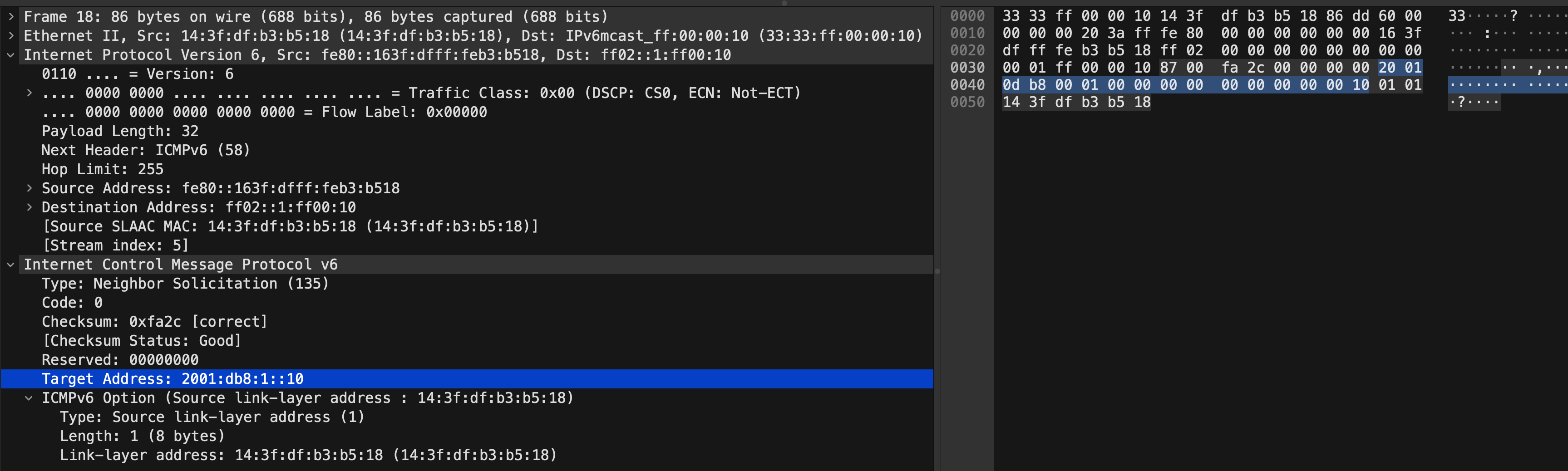
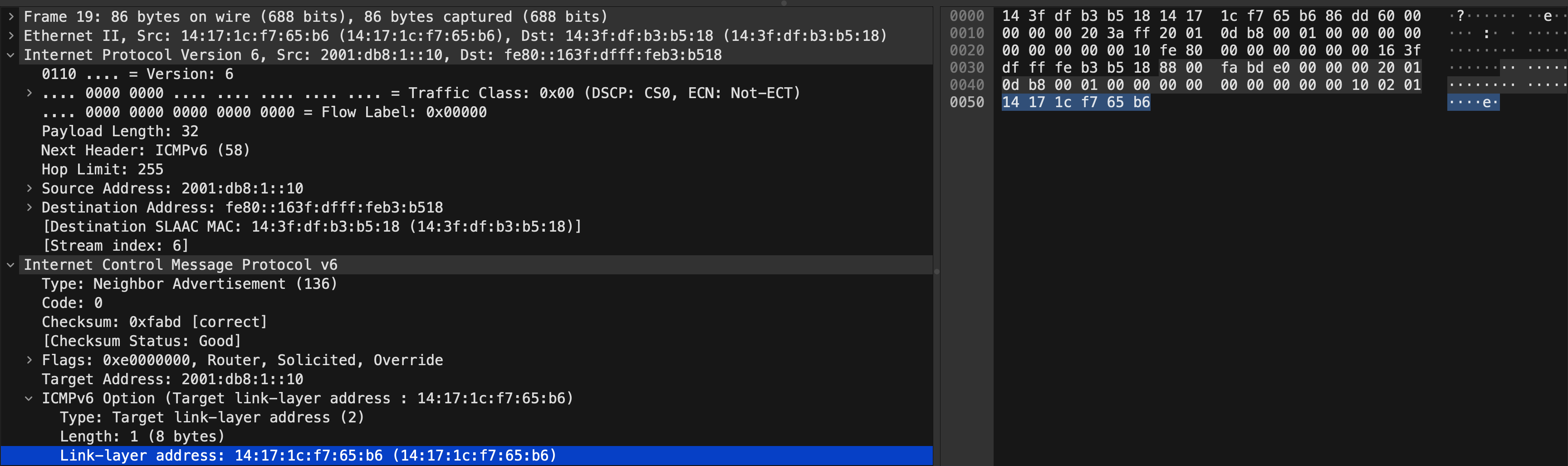
Neighbor Advertisment
- ICMPv6 Type 136
- Replacement to ARP reply in IPv4
- It will be unicast
Comparison with ARP, ICMP and DHCP payloads in IPv4
ARP Request = NS
ARP Reply = NA
GARP = DAD
Host’s ARP Request to Gateway = RS
Gateway’s ARP Reply to Host = RA
Manual IP address assignment or DHCP = Autoconfiguration
ICMP Redirect = ICMPv6 Redirect
DHCP = DHCPv6
What is Solicited Node Multicast address?
- Multicast group where every ipv6 interface will subscribe to it.
- Used for duplicate detection (DAD)
What is SLAAC or Auto Configuration?
- IPv6 address generated locally and assigned to the interface.
- Eliminates static and DHCPv6 address assignments.
show commands on Arista:
show ipv6 interface
show ipv6 neighbors
show ipv6 nd ra neighbors
show ipv6 route host
Last updated: Fri May 29 2026
ipv6